

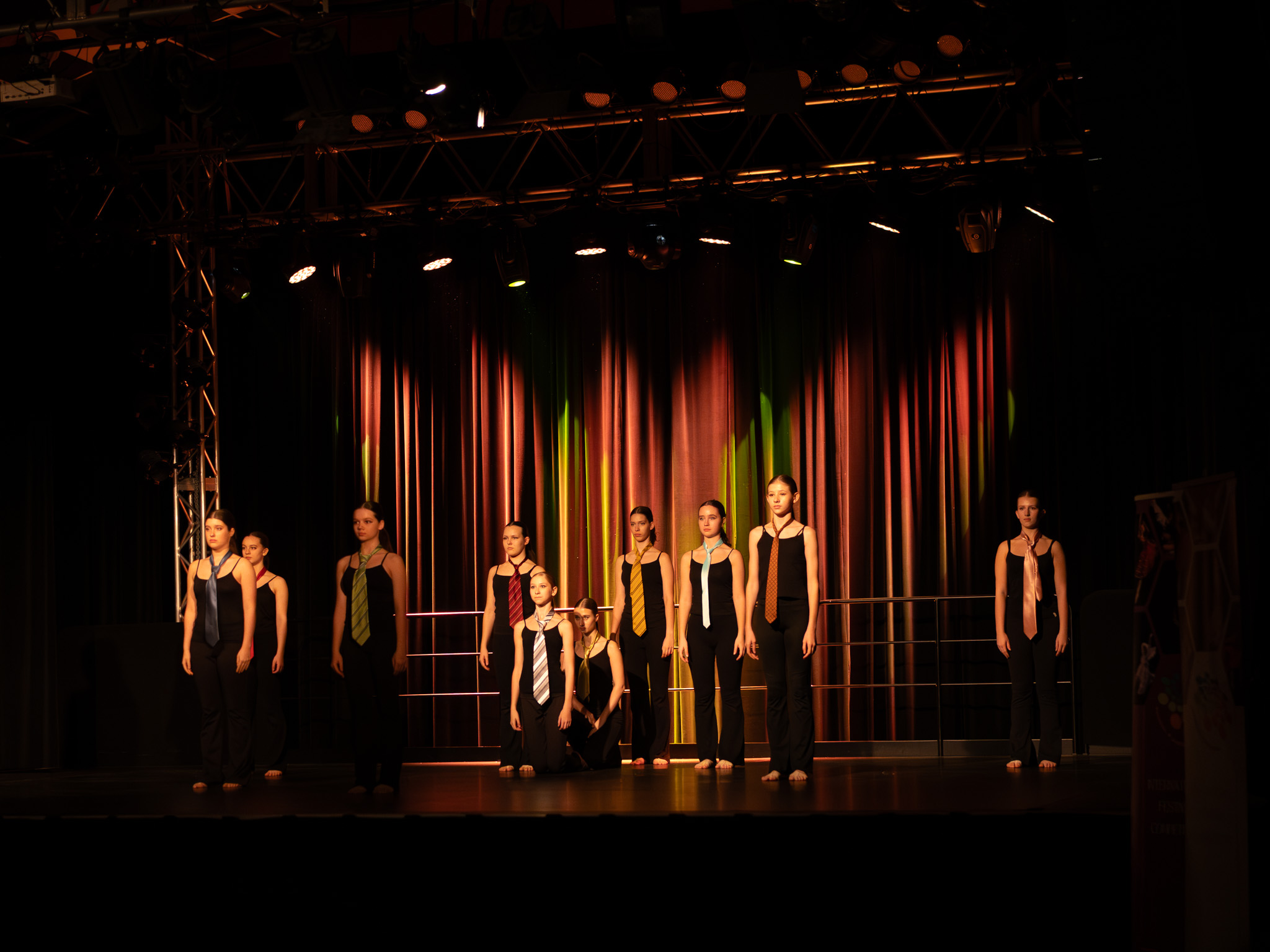
Synchronization is often the first element the jury notes in their evaluation sheets.
You can hope as much as you like that “the strongest dancers in the front row will save the performance,” but there is one tricky detail: the movements of those standing in the third line always reveal the real level of preparation. Even if small technical flaws can be hidden, a lack of unity becomes visible immediately.
We have gathered a whole arsenal of proven methods to help ensure that the ensemble looks not like a group of charming snowflakes scattering in different directions, but like a truly unified organism.
The Three-Tempo Method
The foundation of successful work on synchronization is gradual practice of the choreography at different tempos.
Imagine that you are not simply preparing a performance, but assembling a mosaic into a single picture where every fragment has its place.
Slow tempo (50–60% of the original)
- Children carefully study every movement without rush or haste.
- The teacher has the opportunity to catch and correct mistakes before they become habits.
- Muscle memory is formed so that during the concert movements are performed confidently and consistently.
- Transitions between movements are practiced to avoid the impression that dancers are trying to remember where to go next. Synchronization means the absence of chaos, when everyone knows their role and feels the rhythm of the overall composition.
Medium tempo (80–90%)
- This is the main speed of most rehearsals.
- Children learn not only to repeat movements but to understand what and how they are doing.
- They analyze their positions within a pair or ensemble.
- They begin adding emotion so the performance becomes expressive.
Concert tempo (100–105%)
- The final stage, when the number should sound like a complete composition.
- Participants feel confidence and lightness.
- They dance without excessive tension, with the necessary energy.
Visual Quality Control
Regular photography or video recording is your best ally in the pursuit of synchronization.
What does this provide?
- Children clearly see where their line or movement angle differs from the rest of the group.
- It becomes easier to explain why it is important to hold the body, arms, and legs in the same way.
- The concept of “clean” execution develops — when the eye does not search for mistakes because everything looks harmonious and cohesive.
- It motivates self-control: children learn to notice small inaccuracies themselves and strive to correct them without reminders.
Psychological Aspects of Synchronization
True synchronization is not only about technique but also about the atmosphere within the group.
To achieve this:
- Create an atmosphere of trust where mistakes are not a reason for embarrassment but a step toward improvement.
- Teach children to feel the rhythm and movement of those dancing beside them.
- Explain that ensemble performance means everyone literally “breathes together” and simultaneously observes their neighbors.
You can imagine it like driving a car: hands hold the steering wheel, one hand shifts gears, each foot performs its own task, and the head constantly turns to monitor what other drivers are doing. Dancing works the same way: you are responsible for yourself, but at the same time you feel the overall direction.
Technical Techniques
-
Stops on Count
Like a game of “Stop!”: on a signal everyone freezes in position. This helps check muscle strength, line accuracy, and the ability to hold a pose.
-
Diagonal Practice
Performing movements one by one allows the teacher to observe each participant individually and give precise corrections.
-
Pair Work
This becomes a real school of mutual control: one dancer reminds the other about the amplitude of movements, while the other reminds about posture or a smile.
-
The Secret Trick: “Group Observation from the Side”
Ask part of the group to dance while the rest carefully observe and then respectfully explain what worked best and what still needs improvement. This teaches dancers to see themselves from the outside and work constructively.
-
Support from Older Groups
In many ensembles there are older participants who studied the same choreography last year or over several seasons. It is useful to involve them as mentors: they can help younger dancers with choreography, explain movement details, and demonstrate confident performance.
And who knows — perhaps in this way you are quietly nurturing your future choreographer’s assistant or rehearsal coach 😊
Homework for Developing Synchronization
Once a week, practice the main fragments of the dance at home in a slow tempo in front of a mirror or while recording yourself on video. Then watch the recording and note what can be improved. You can also try performing the movements “on count” without music — this helps develop a better sense of timing and clarity in transitions.